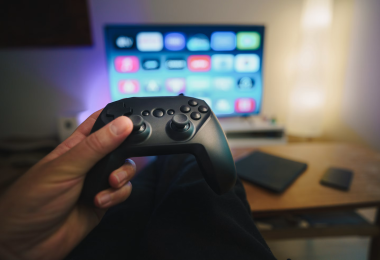
A decade ago, watching television in France meant sitting back, letting a broadcast schedule dictate the evening, and reacting to whatever appeared on screen. That model has quietly collapsed. Viewers now expect to shape outcomes as they happen, whether that means voting on a talent show result within seconds or placing a live wager while a match is still being played. The shift is not cosmetic – it reflects a deeper change in how French audiences relate to media altogether.
Gaming shows this shift most bluntly. Live-dealer tables and real-time betting have pulled players away from static, pre-recorded games faster than anyone predicted. A platform such as sankra casino online builds its whole appeal around that immediacy, letting someone react to a spinning wheel or a freshly dealt hand as it happens rather than finding out the result later. That same appetite now shapes how audiences use every screen in the house.
From the Salon to the Second Screen
French households have long treated television as a communal ritual – dinner finished, everyone gathered in the salon, one channel chosen for the whole family. Streaming fragmented that ritual first, letting each person pick their own show. Live interactivity fragmented it again, because now the second screen, usually a phone, has become the primary site of engagement even when the television stays on in the background.
Surveys from French media regulators have tracked this for years: simultaneous device use during broadcasts rose sharply after 2018, and platforms responded by building companion apps, live chat overlays, and voting mechanics directly into programming. The audience stopped being a recipient of content and became a participant shaping its direction, even if only in small, symbolic ways.
Why Real-Time Feedback Feels Different
Passive viewing asks for attention. Real-time participation asks for a decision, and decisions carry weight that passive attention never does. A viewer who votes for a contestant, taps a live poll, or places a bet during a football match has skin in the outcome, however small. That small stake changes the emotional texture of watching.
Behavioral researchers describe this as an escalation from spectatorship to agency. The brain processes an outcome differently when a person believes their input mattered, even marginally, compared to when they simply observed. French broadcasters and platform operators have leaned into this distinction deliberately, because engagement metrics improve substantially once a viewer has something at stake.
How the Technology Actually Works
Live interactivity depends on infrastructure that did not exist in a usable form until relatively recently: low-latency streaming, synchronized data feeds, and mobile networks fast enough to register a tap or a wager before a moment has passed. Below is a simplified comparison of how traditional broadcast formats differ from real-time interactive ones.
| Feature | Traditional Broadcast | Real-Time Interactive Format |
| Viewer role | Passive observer | Active participant |
| Feedback loop | Delayed (next episode, survey) | Instant (seconds) |
| Data used | Ratings, post-hoc surveys | Live engagement, in-session behavior |
| Typical device | Television only | Television plus mobile/second screen |
| Outcome influence | None | Votes, wagers, chat-driven choices |
The underlying architecture usually involves a central server broadcasting state changes – a new card dealt, a poll closing, a score updating – to thousands of connected clients within a fraction of a second. Any noticeable lag breaks the illusion of participation, so providers invest heavily in reducing it.
The Role of Mobile-First Design
Nearly all of this shift rides on smartphones rather than desktop computers or traditional television remotes. French mobile penetration reached near-saturation years ago, and 4G/5G coverage across the country made split-second interactions reliable even outside major cities. Designers had to rethink interfaces for thumbs and small screens rather than living-room displays viewed from a distance.
This meant simplifying decision points. A live poll button needs to be tappable in under a second without hesitation; a betting slip needs to confirm a wager before the next play begins. Interfaces that once assumed a leisurely, seated viewer now assume someone glancing at a phone between conversations or during a commute.
What This Means for Broadcasters and Platforms
Traditional broadcasters in France, including public networks, have had to adapt programming formats to accommodate interactivity or risk losing audiences to platforms built around it from the ground up. Some have partnered with tech companies to add real-time layers to existing shows; others have watched younger viewers migrate entirely toward interactive-first platforms.
The Economics of Engaged Attention
The economic incentive is straightforward: engaged viewers stay longer, return more often, and generate richer behavioral data than passive ones ever could. Advertisers picked up on this quickly, and budgets followed, moving away from formats scored by panel surveys and toward ones where attention shows up second by second in the data.
Where the Trend Goes Next
Analysts expect broadcast and interactive gaming formats to blur further as augmented reality overlays and synchronized multiplayer experiences mature. A French audience raised on instant feedback is unlikely to accept purely passive formats again.
What began as a niche behavior among younger, tech-forward viewers has become the default expectation across age groups. The remote control, once the single tool of viewer agency, has effectively been replaced by the phone in hand – a small object that turned an entire national audience from spectators into participants.